Personal / Case study
ML / DevOps Engineer (Personal project)
Iris MLOps Pipeline

Version-controlled data and training runs
RandomForest classifier with evaluation
Model packaged and served through FastAPI
Reproducible env: venv + pinned requirements
Tech Stack
Description
This project exists because training a model is the easy half. I wanted the other half: a workflow where the data, the experiment and the served model are all reproducible.
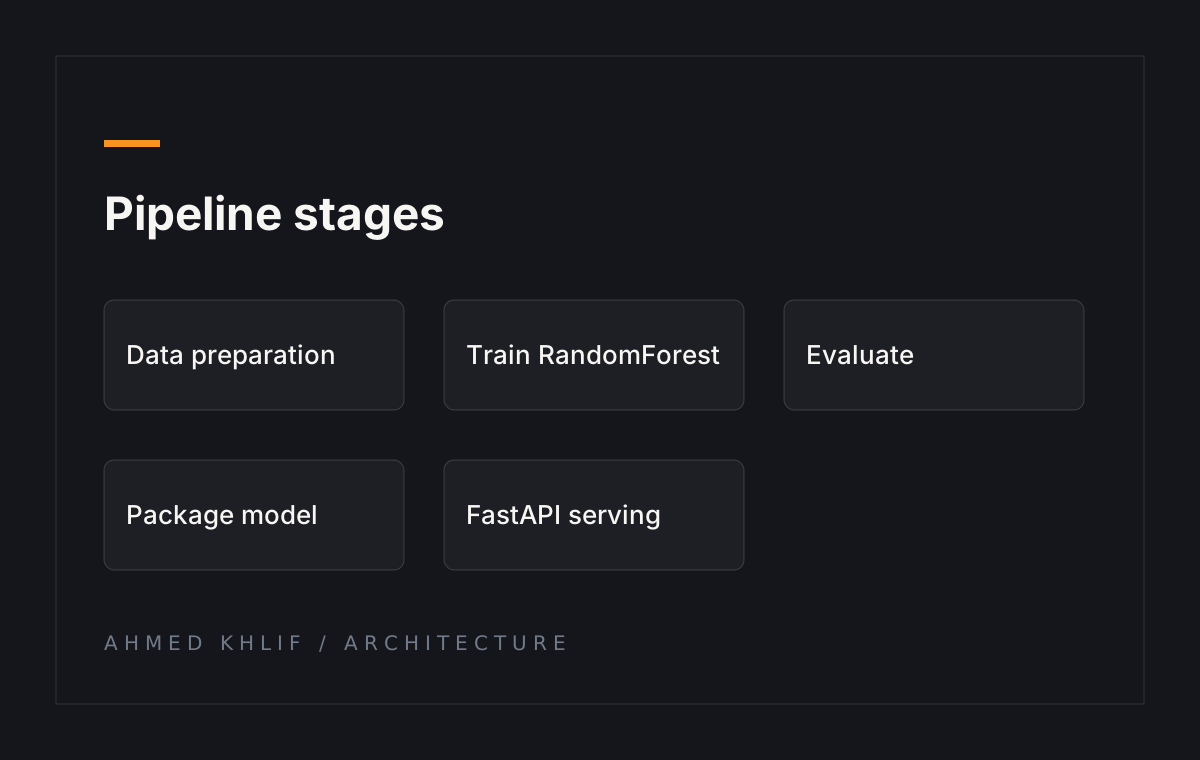
The pipeline covers data preparation, training a RandomForestClassifier, evaluating it, packaging the artefact and serving predictions through a FastAPI endpoint.
Environments are pinned and virtualised so a fresh machine produces the same result, and each stage is a standalone script — which makes the whole thing something you can inspect rather than trust.
It is a small dataset on purpose. The point of the project is the shape of the pipeline, not the accuracy on Iris.
- Built an end-to-end MLOps pipeline for Iris flower classification.
- Trained and evaluated a RandomForestClassifier with reproducible runs.
- Packaged the model artefact and served predictions via a FastAPI endpoint.
- Kept environments reproducible with virtualenv and pinned requirements.
- Structured each stage as an independent, re-runnable script.
Page Info
Pipeline stages
Data preparation → training → evaluation → packaging → serving. Each stage is a script you can re-run and get the same result from.
Inference API
The trained model is exposed through a FastAPI endpoint, so the pipeline ends in something a product could actually call.